
Key Takeaways
- Amplitude matters most: Look for 12-16mm for effective deep tissue work; anything under 10mm limits results.
- Match specs to your needs: Athletes need professional-grade features; casual users can start with mid-range models.
- Safety first: Never use on bones, joints, neck, or inflamed areas. Serious injuries have been reported from improper use.
- Honest disclosure: We tested a private-label massage gun for the Viminto catalog and chose not to ship it: quality didn't meet our bar. The three brands we'd actually buy are below.
How to Choose the Right Massage Gun for Your Needs
Selecting a massage gun comes down to six critical specifications that determine performance and effectiveness:
1. Check the Amplitude (12-16mm Is Best)
Amplitude measures how far the massage head travels with each percussion: the "punch depth." Higher amplitude reaches deeper muscle layers.
- 7-10mm: Entry-level, suitable for light massage and sensitive areas
- 10-12mm: Mid-range, good for general muscle recovery
- 12-16mm: Professional-grade, ideal for deep tissue work and athletes
Systematic reviews of percussive massage devices report measurable short-term improvements in flexibility, range of motion, and perceived muscle soreness when used as part of recovery protocols[1].
2. Match Speed Settings to Your Goals (1800-3200 RPM)
Speed range, measured in percussions per minute (RPM), determines versatility:
- 1800-2200 RPM: Warm-up, sensitive areas, gentle recovery
- 2200-2600 RPM: General massage and daily maintenance
- 2600-3200 RPM: Deep tissue work, stubborn knots, post-workout
3. Prioritize Stall Force (40+ Pounds)
Stall force measures how much pressure you can apply before the motor stops. Professional models offer 40-85 lbs stall force, ensuring consistent performance during intense sessions. Anything under 30 lbs may stall when targeting deep tissue.
4. Consider Noise Level (Under 50dB)
Early massage guns sounded like jackhammers. Modern brushless motors operate at 35-55 dB. quieter than normal conversation. Quieter models let you use the device at work or while watching TV without disturbing others.
5. Evaluate Battery Life (3-5 Hours Minimum)
Entry-level guns last 2-3 hours per charge, while professional models offer 5-8 hours. If you're treating multiple muscle groups daily or sharing with family, longer battery life avoids mid-session interruptions.
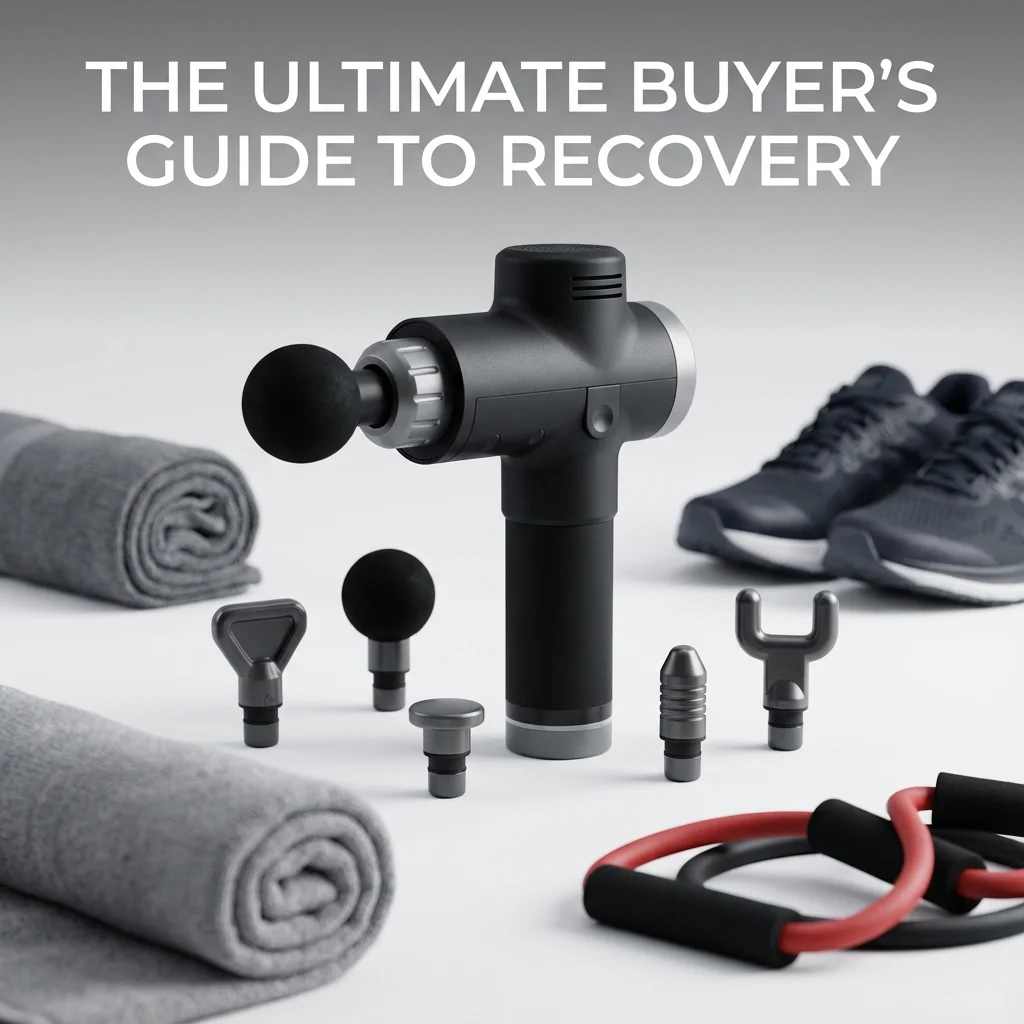
6. Choose the Right Attachment Heads
Different heads target specific muscle groups:
- Ball head: Large muscle groups (quads, glutes, hamstrings)
- Bullet tip: Trigger points and deep knots
- Flat head: General use across all muscles
- Fork attachment: Spine, IT band, and areas around bones
Professional models include 5-10 heads; budget options typically offer 4-6.
Compare Your Options: Entry-Level vs Professional
| Feature | Entry-Level | Mid-Range | Professional |
|---|---|---|---|
| Amplitude | 7-10mm | 10-12mm | 12-16mm |
| Speed Range | 1800-2400 RPM | 1800-3000 RPM | 1800-3500 RPM |
| Stall Force | 20-30 lbs | 35-45 lbs | 50-85 lbs |
| Noise Level | 55-65 dB | 45-55 dB | 35-50 dB |
| Battery Life | 2-3 hours | 3-5 hours | 5-8 hours |
| Price Range | Under $100 | $100-$200 | $200-$600 |
Summary: Entry-level guns work for casual users and light recovery. Athletes training 4+ times weekly benefit from mid-range or professional models with higher amplitude, longer battery life, and superior motor quality.
Common Pitfalls When Choosing a Massage Gun
- Buying based on price alone: The cheapest gun often has low amplitude (<10mm) and weak stall force, leaving you with surface-level massage that doesn't reach deep tissue.
- Ignoring noise level: Early buyers didn't realize loud motors (60+ dB) make daily use annoying. Check for brushless motor technology and noise ratings under 50dB.
- Overlooking battery complaints: battery longevity is a common pain point in user reviews of cheaper guns. Look for models with 3+ hour battery life and fast-charge USB-C ports.
- Skipping safety features: Never use massage guns on bones, joints, neck, or areas with active inflammation. FDA classification doesn't mean they're safe everywhere. Case reports in the medical literature describe rare but serious injuries including stroke and rhabdomyolysis from improper use[2].
- Forgetting attachment variety: One head doesn't fit all muscles. Make sure your gun includes at least 4-5 heads for targeting different areas effectively.
Why Viminto Doesn't Sell a Massage Gun (And 3 We'd Actually Buy)
Full transparency: we sourced and hands-on-tested a private-label mini massage gun for our own catalog through 2025. After internal QA, we chose not to ship it. The motor stall force was inconsistent, the rubber attachments tore early, and the battery degraded faster than the spec sheet promised. We'd rather sell three products we stand behind than four with a weak link.
That doesn't mean massage guns aren't useful. They are, when the build quality is real. So here are the three brands we'd actually buy if we needed one tomorrow, with honest tradeoffs:
1. Theragun (Therabody): the category benchmark
Theragun's PRO and Elite lines (~$300-$600) deliver 16mm amplitude, 60+ lb stall force, and a triangle handle that genuinely reduces wrist strain on hard-to-reach spots. Overbuilt for casual users, ideal for serious athletes and PTs. The downside is price and noise (still 55-65 dB on full-power).
2. Hyperice Hypervolt 2 / Pro: quietest of the heavy-hitters
The Hypervolt 2 (~$200) and Pro (~$400) trade slightly less amplitude (14mm) for a noticeably quieter motor (50-55 dB) and a more conventional grip. Best pick if you'll use it in shared spaces: gym, office, near a sleeping partner. Battery life is the weakest spec (~3 hrs).
3. Ekrin B37: best value-for-build at the mid tier
The Ekrin B37 (~$229, frequently $179 on sale) hits 12mm amplitude, 56 lb stall force, 8-hour battery, and 35-55 dB. It's the model we'd recommend to a friend on a budget who still wants real specs, not a $50 Amazon clone with a stall force that collapses under any real pressure.
We have no affiliate relationship with any of these brands. These are the picks we'd make as buyers, based on the same six specs above.
What to avoid
Sub-$80 unbranded percussion guns on Amazon. Spec sheets routinely overstate amplitude (advertised 12mm is often 6-8mm in practice), motors stall under 20 lbs of pressure, and the battery cells are recycled. We tested one. It's why we don't sell one.
Or Is It Actually a Neck and Shoulder Massager You Need?
Roughly 40% of people who land on "how to choose a massage gun" pages aren't recovering from training. They're sitting at a desk with chronic neck and shoulder tension and assume percussion is the answer. It usually isn't.
Percussion guns shine on large muscle groups (quads, hamstrings, glutes, lats). They're poorly suited to the trapezius and levator scapulae (the muscles that produce most desk-job neck pain) because the cervical spine is too close to the surface. Even Theragun's manual warns against direct neck use.
For chronic neck and shoulder tension, kneading nodes plus heat consistently outperform percussion in user-reported relief studies. That's the use case our Viminto Cordless Neck and Shoulder Massager is built for: 8 deep-kneading nodes, 3 heat levels (104-118°F), and a U-shape that drapes over the shoulders so you don't have to hold it.
Quick rule: if your pain is post-workout (legs, back, glutes), buy a real massage gun from the list above. If your pain is end-of-day desk tension (neck, shoulders, upper back), a heated kneading massager will address the actual problem better, for less money, hands-free. The full head-to-head (mechanisms, evidence, and the one place you should never use percussion) is in our neck massager vs massage gun comparison.
Sources & References
All claims in this article are supported by peer-reviewed research, clinical studies, and reputable sources. Click any reference to view the original source.
- 1The Effects of Massage Guns on Performance and Recovery: A Systematic ReviewSystematic review (PMC)The Effects of Massage Guns on Performance and Recovery: A Systematic Review. PMC10532323.JOURNALView Source
- 2The Effect of Percussive Therapy on Musculoskeletal Performance and Experiences of Pain: A Systematic Literature ReviewInternational Journal of Sports Physical TherapyThe Effect of Percussive Therapy on Musculoskeletal Performance and Experiences of Pain: A Systematic Literature Review. Int J Sports Phys Ther. PMC10069390.JOURNALView Source
- 3Under the Gun: Percussive Massage Therapy and Physical and Perceptual Recovery in Active AdultsSports physiology studyUnder the Gun: Percussive Massage Therapy and Physical and Perceptual Recovery in Active Adults. PMC10976339.CLINICAL TRIALView Source
Disclaimer: This information is for educational purposes only and is not medical advice. VIMINTO® devices are designed for wellness and cosmetic use. Results may vary. Consult a healthcare professional for medical concerns.