Key Takeaways
- Two non-overlapping mechanisms: microcurrent stimulates facial muscles (the toned look), LED supports skin texture and collagen: pairing is complementary coverage, not a proven multiplier
- The LED half carries the stronger evidence: Barolet 2009 measured +31% procollagen in light-exposed skin tissue; human trials show texture and fine-line gains over 8–15 weeks
- The one ordering rule: LED first on clean bare skin, conductive gel and microcurrent second: gel would block the light
- Frequency pattern from the research: LED daily, microcurrent 3–5×/week; on busy days run just the five-minute LED half
- Hard rule: no microcurrent with a pacemaker or implanted electrical device; pregnancy and facial-nerve conditions are ask-your-doctor cases
Why combine microcurrent and LED at all?
Because they work on different layers of the same goal. LED light is absorbed by cells and supports collagen production and skin texture; microcurrent stimulates the facial muscles underneath, producing the toned, “lifted” look its users chase. One addresses the canvas, the other the frame, which is why pairing them is mechanism-logical rather than redundant.
The honest framing up front: no published trial proves a precise “synergy multiplier” from combining them. What the literature supports is each modality independently, plus the common-sense observation that two non-overlapping mechanisms can be layered without interfering. Think of “synergy” as complementary coverage, not multiplication.
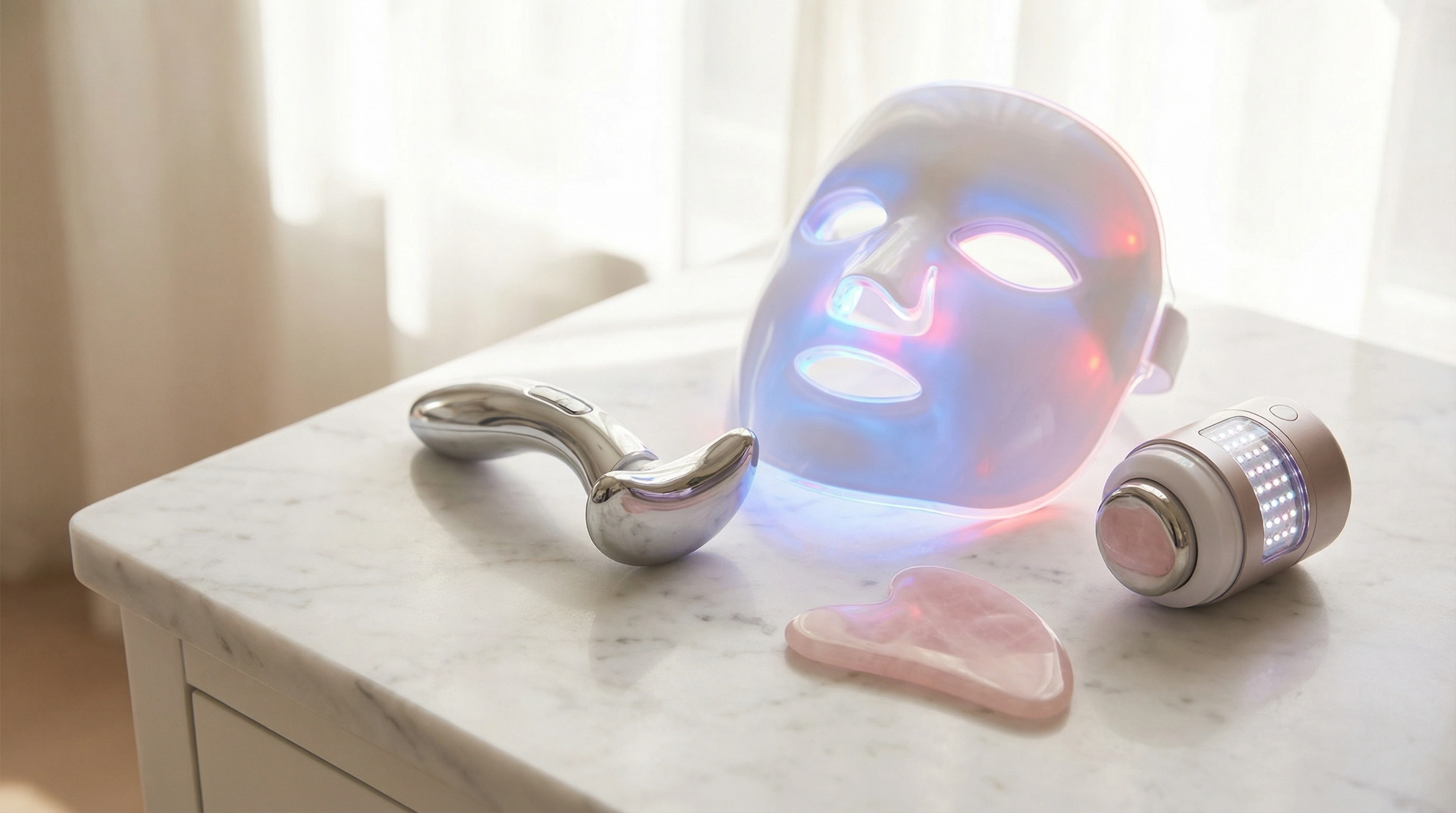
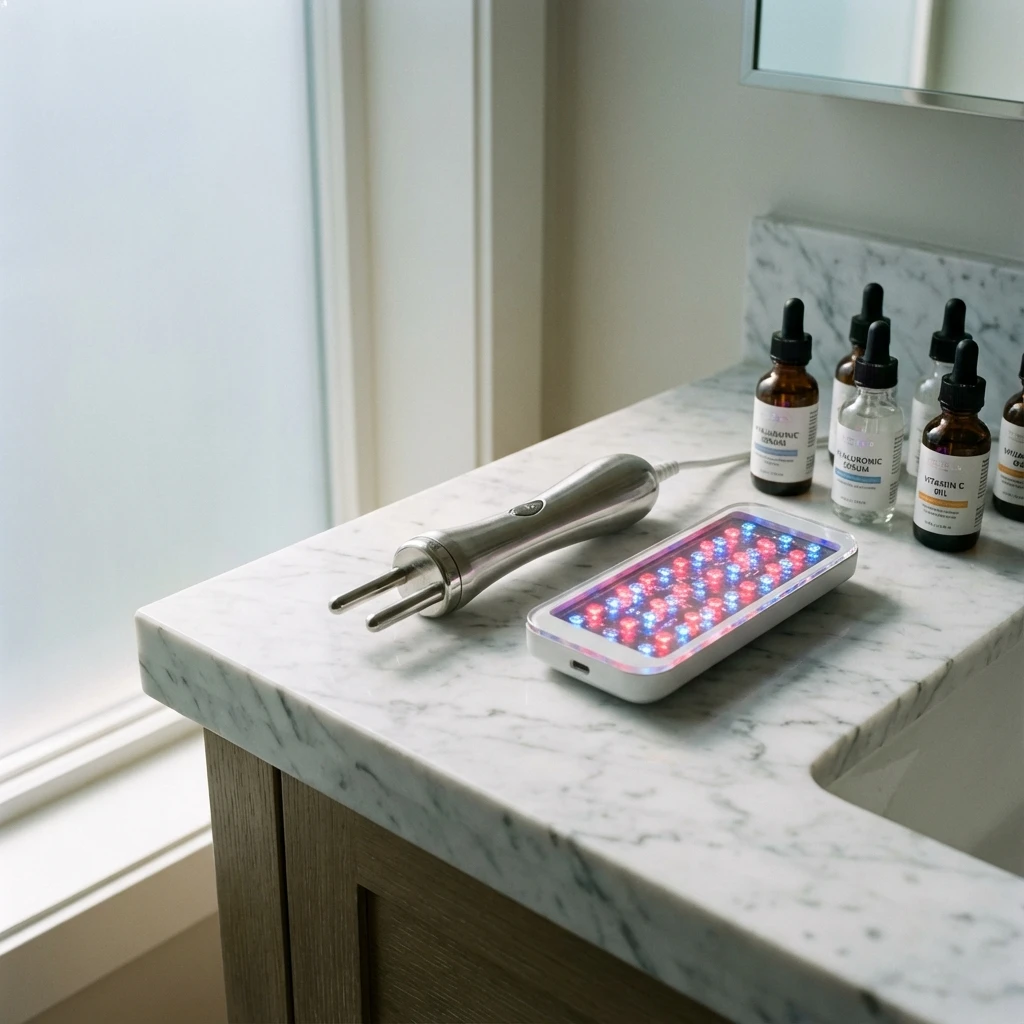
Professional salons have run combined current-and-light sessions for years on dedicated equipment. The at-home version is the same idea split across consumer devices and spread over the week.
What does the evidence show for each half?
The LED half carries the stronger file. Lab work (Barolet et al., 2009) measured a 31% increase in procollagen in light-exposed human skin tissue[1], and human trials (Wunsch & Matuschka 2014, Lee et al. 2007) found higher collagen density, smoother texture, and visibly reduced fine lines after multi-week red-light protocols[2][3]. The microcurrent half rests on smaller trials plus four decades of professional salon use.
- LED (630–660 nm): the best-evidenced at-home modality: results arrive over 8–15 weeks and are dose-and-repeat phenomena. The deep dive lives in what red light actually does. If you are choosing an LED device, see our honest Viminto vs FOREO BEAR comparison.
- Microcurrent: descended from professional units in use since the 1980s; published at-home results are real but modest, always technique- and consistency-dependent, and entirely reliant on conductive gel.
For where these two sit against gua sha and other tools, our three-way device comparison grades the full field.
The microcurrent side deserves an honest accounting too.[4] Reviews of home facial devices describe low-level electrical stimulation of the facial muscles as a plausible route to a firmer, more toned look, while noting that the controlled evidence is thinner and the effect is largely maintenance rather than a permanent change. That is the fair summary: LED has the deeper research file for skin quality, microcurrent has a lighter file plus four decades of professional salon use, and the two act on different tissue. Neither claim needs inflating for the pairing to make sense, because they are not competing for the same result.
How do you run both in one routine?
Light first, current second: LED works best on clean, bare skin, and microcurrent needs a conductive gel layer that would block light. Beyond that one ordering rule, the combination is logistics, not science.
- Cleanse. Both halves need product-free skin to start.
- LED session, 5–10 minutes. Slow passes over cheeks, forehead, jaw, neck, or wear-and-wait with a mask-style device.
- Apply conductive gel generously wherever the microcurrent device will travel.
- Microcurrent, 5–10 minutes. Upward, outward strokes following your device’s pathing guide.
- Finish normally. Rinse residual gel, then moisturizer and the rest of your routine.
Frequency that matches the research patterns: LED daily or near-daily; microcurrent 3–5 sessions a week. On busy days, run just the LED half (five passive minutes) and keep the streak alive.
The reason the order matters comes down to how each half reaches its target. Light has to be absorbed by cells in the skin to do anything, and the leading explanation is that this absorption supports more efficient cellular energy use.[5] A conductive gel layer, applied for the microcurrent pass, sits on top of the skin and would scatter light before it arrives, so the light session simply has to come first. Beyond that single rule, the sequence is convenience, not chemistry.
What results should you honestly expect?
The same weeks-long arc as every legitimate device routine, with each half contributing its own lane: microcurrent’s toned look shows earliest (sometimes within sessions, fading between them at first), while LED’s texture and fine-line changes accumulate over 5–12 weeks. Neither is permanent. Both fade back toward baseline if you stop entirely.
What that looks like in the mirror: a temporary post-session freshness in the first weeks, “rested” skin around weeks 3–4, and the cumulative texture changes from there, judged in honest daylight, not ring-light selfies. Maintenance matters more than intensity: most long-term users settle into LED most days plus microcurrent a few evenings a week, indefinitely.
Set the calendar honestly and the pairing is easy to stick with. The toned look from the current tends to show first and fade fastest between sessions, so it rewards a steady three-to-five-nights-a-week rhythm rather than occasional bursts. The light-driven changes move on the slower schedule every trial in this article used, arriving over roughly 8–15 weeks and then holding only while the habit holds. Judged in ordinary bathroom light rather than a ring-lit selfie, that combined arc is modest, real, and entirely dependent on showing up. The upside is that neither half asks for much: a few gel-and-current minutes, a few clean-skin light minutes, and the patience to let two slow processes compound side by side over a couple of months.
Do you need a combined device?
No. Professional combined units exist (CACI’s salon systems are the famous example, at clinic prices), but at home the practical pattern is two dedicated tools used in sequence, or starting with one half and adding the other later.
Where our catalog honestly fits: the Viminto 3-in-1 Face Massager covers the light half: 630 nm red LED with warmth and vibration massage in a five-minute auto-timed pass. It is not a microcurrent device, and we will not pretend otherwise; if the lifted-look lane matters to you, pair it with a dedicated microcurrent tool and gel. Build the sequencing into the evening block of your daily routine and the combination runs itself.
Who should skip microcurrent?
Skip microcurrent entirely if you have a pacemaker or any implanted electrical device. This is the category’s one hard rule. Ask your doctor first if you are pregnant (research is limited) or managing any facial-nerve condition, and keep any device off broken or irritated skin until it settles.
The LED half has gentler exceptions: photosensitizing medication is the check-with-your-doctor case, and eyes stay closed near bright LEDs for comfort. Neither modality involves UV. As with everything we publish: wellness guidance for cosmetic appearance, not medical advice. Persistent skin concerns belong with a professional.
Sources & References
All claims in this article are supported by peer-reviewed research, clinical studies, and reputable sources. Click any reference to view the original source.
- 1Barolet D, Roberge CJ, Auger FA, Boucher A, Germain L (2009)Regulation of skin collagen metabolism in vitro using a pulsed 660 nm LED light sourceJournal of Investigative DermatologyBarolet D, Roberge CJ, Auger FA, Boucher A, Germain L. Regulation of skin collagen metabolism in vitro using a pulsed 660 nm LED light source: clinical correlation with a single-blinded study. Journal of Investigative Dermatology. 2009;129(12):2751-2759.CLINICAL TRIALView Source
- 2Wunsch A, Matuschka K (2014)A controlled trial to determine the efficacy of red and near-infrared light treatment in patient satisfaction, reduction of fine lines, wrinkles, skin roughness, and intradermal collagen density increasePhotomedicine and Laser SurgeryWunsch A, Matuschka K. A controlled trial to determine the efficacy of red and near-infrared light treatment in patient satisfaction, reduction of fine lines, wrinkles, skin roughness, and intradermal collagen density increase. Photomedicine and Laser Surgery. 2014;32(2):93-100.CLINICAL TRIALView Source
- 3Lee SY, Park KH, Choi JW, et al. (2007)A prospective, randomized, placebo-controlled, double-blinded, and split-face clinical study on LED phototherapy for skin rejuvenationJournal of Photochemistry and Photobiology B BiologyLee SY, Park KH, Choi JW, et al. A prospective, randomized, placebo-controlled, double-blinded, and split-face clinical study on LED phototherapy for skin rejuvenation. Journal of Photochemistry and Photobiology B Biology. 2007;88(1):51-67.CLINICAL TRIALView Source
- 4Bu P, Duan R, Luo J, et al. (2024)Development of home beauty devices for facial rejuvenation: establishment of efficacy evaluation systemClinical Cosmetic and Investigational DermatologyBu P, Duan R, Luo J, et al. Development of home beauty devices for facial rejuvenation: establishment of efficacy evaluation system. Clinical Cosmetic and Investigational Dermatology. 2024;17:571-583.JOURNALView Source
- 5Avci P, Gupta A, Sadasivam M, et al. (2013)Low-level laser (light) therapy (LLLT) in skin: stimulating, healing, restoringSeminars in Cutaneous Medicine and SurgeryAvci P, Gupta A, Sadasivam M, et al. Low-level laser (light) therapy (LLLT) in skin: stimulating, healing, restoring. Seminars in Cutaneous Medicine and Surgery. 2013;32(1):41-52.JOURNALView Source
Disclaimer: This information is for educational purposes only and is not medical advice. VIMINTO® devices are designed for wellness and cosmetic use. Results may vary. Consult a healthcare professional for medical concerns.