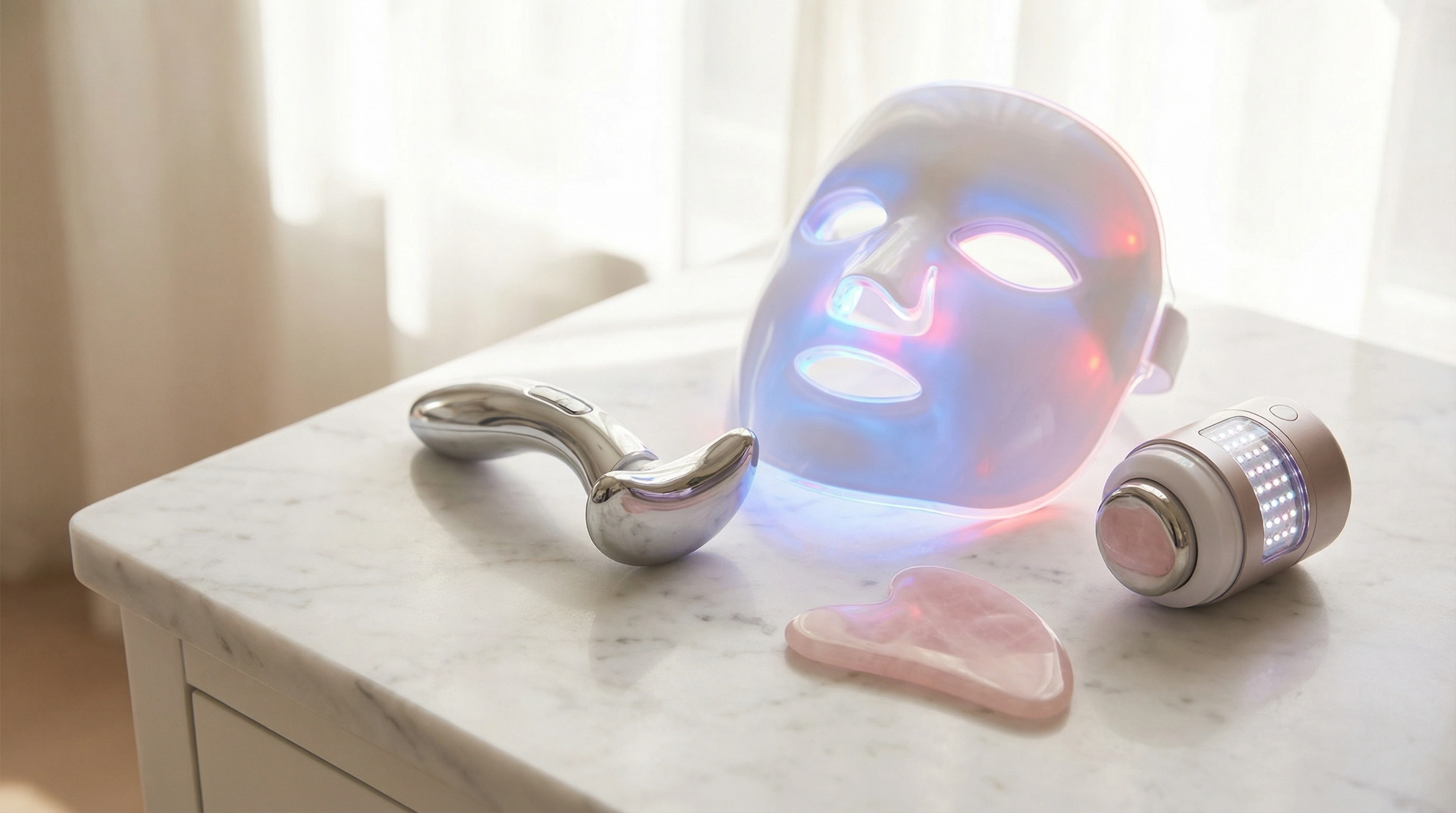
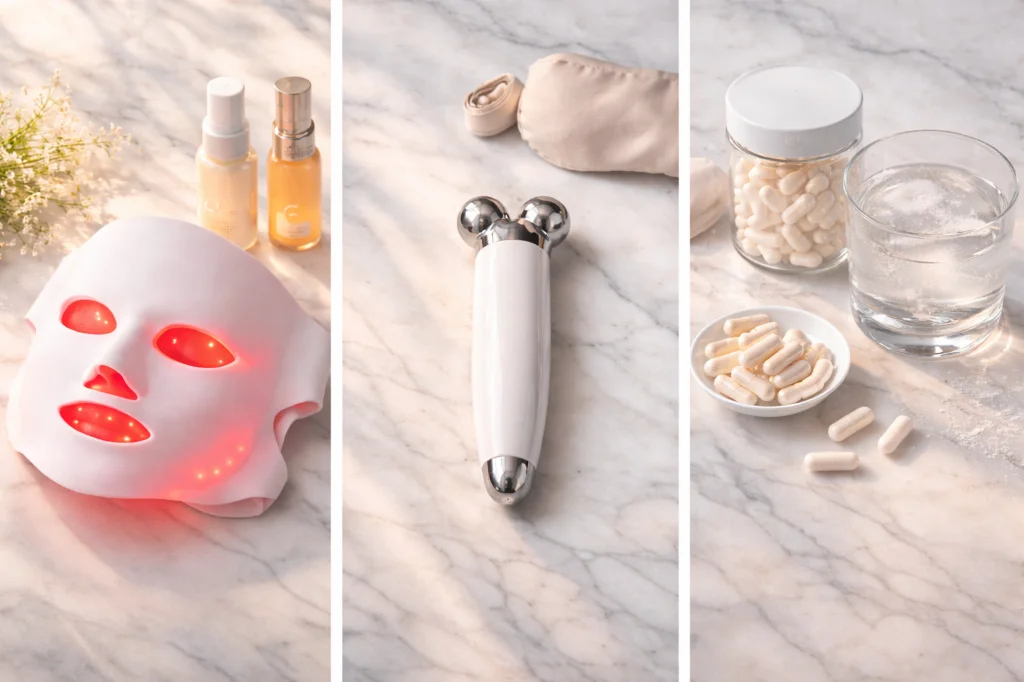
Key Takeaways
- A sustainable wellness tech routine is ~25 minutes spread across existing anchors: 7 at the morning sink, 0 devices during the workday, 20 in the evening wind-down
- Morning: cleanse → 5-minute red LED pass → moisturizer + SPF; sunscreen is the only non-negotiable step
- Workday: geometry and movement beat gadgets: screen at eye height, 30-second breaks every 30–60 minutes, chin tucks
- Evening: 15-minute heated neck massage anchored to couch time, 60 seconds of water flossing before brushing, optional LED catch-up
- Start with ONE device and one anchor for two weeks. Launching everything at once is how routines die; visible payoffs cluster after weeks 4–8
What is a daily wellness tech routine?
A daily wellness tech routine is a small set of device-anchored habits (a few minutes each) attached to things you already do every day: waking up, sitting at a desk, brushing your teeth, watching TV. The devices do not replace sleep, water, or movement; they make the maintenance minutes consistent and pleasant enough that they actually happen.
The whole framework rests on one finding that shows up everywhere in habit research: routines anchored to existing events survive, and routines that need willpower die by Thursday. So instead of a 45-minute “protocol,” this guide maps about 25 total minutes across the natural anchors of a normal day (morning sink, workday desk, evening couch) using devices for skin, teeth, and the neck and shoulders that carry your day’s tension.
The day, in three anchors
- 1Morning sink, ~7 minCleanse, a 5-minute red LED pass, then moisturizer and SPF.
- 2Workday desk, 0 devicesScreen at eye height, a 30-second move every 30 to 60 minutes, chin tucks.
- 3Evening couch, ~20 minA 15-minute heated neck massage, 60 seconds of water flossing, lights down.
What does a realistic morning routine look like? (7 minutes)
Cleanse, five minutes of red LED on clean skin, then moisturizer and sunscreen. That is the entire morning block: seven minutes at the sink you already stand at, and the sunscreen is the only non-negotiable in it.
- Cleanse: light works best on clean skin, and you were doing this anyway.
- Five-minute LED pass: a device like the Viminto 3-in-1 runs 630 nm red light with warmth and vibration in slow passes over cheeks, forehead, jaw, and neck; the auto-shutoff times it for you. New to red light? Start with our complete red light guide.
- Moisturizer + SPF: sunscreen protects the collagen you are working to support; skipping it undoes more than any device adds.
Honest scheduling note: if mornings are chaos, move the LED session to the evening block. A routine that bends to your life beats a perfect one you abandon.
Five minutes is the honest dose because the trials that measured real skin change used repeated short sessions over weeks, not marathon exposure.[2] The controlled research behind red light ran dozens of passes across two to four months before collagen density and texture shifts registered on instruments, so a daily five-minute session beats an ambitious twenty-minute one you abandon by Thursday. The device is the easy part; the cadence is the whole game, which is exactly why the routine attaches it to something you already do at the sink.
What should you do during the workday? (zero devices)
Nothing you can buy. The workday block is geometry and movement. Screen at eye height, a 30-second movement break every 30–60 minutes, five chin tucks a few times a day, and water within reach. This is the cheapest, highest-leverage part of the entire routine.
Desk hours are where neck and shoulder tension is manufactured: tilt your head 45° toward a screen and your neck stabilizes the equivalent of roughly 49 pounds[1]. The fix happens during the day, not after it. We wrote the full desk-worker playbook in our tech neck guide, including the 5-minute desk reset.
The routine’s honest hierarchy lives here: a $20 laptop stand and free movement breaks outrank every device in this article. Devices earn their place in the morning and evening blocks. The workday belongs to habits.
That load figure is not a scare statistic, it is the reason the fix belongs inside the workday rather than after it. The muscles that hold a forward head are working for as long as the posture lasts, so the highest-leverage move is interrupting the hold, not soothing the ache at night. Raising the screen to eye height erases most of the tilt, and a thirty-second stand every half hour resets the muscles before fatigue stacks up. None of it costs anything, and it heads off more tension than any evening device can later undo.
What does the evening wind-down look like? (20 minutes)
Three anchors: a 15-minute heated neck massage while you do whatever you already do on the couch, 60 seconds of water flossing before you brush, and lights-down on the way to bed. The block costs almost no extra time because every piece attaches to an existing evening event.
- Couch time → neck reset. A heated kneading device like the cordless neck & shoulder massager works the muscles that held your head up all day[3], hands-free, so the TV episode is the timer. One 15-minute session; the auto-shutoff ends it.
- Bathroom → floss then brush. A cordless water flosser flushes the day out from between teeth in about 60 seconds before brushing: the order that lets toothpaste reach clean surfaces. Skeptical it beats string? We compared them honestly.
- LED catch-up (optional). Missed the morning session? Run it here after cleansing; evening consistency counts exactly the same.
Where do microcurrent and supplements fit?
They are optional additions, not the spine of the routine, and full disclosure: Viminto does not sell either, so take this as straight editorial. Microcurrent pairs fine with LED in the same evening; collagen supplements have moderate, slow-burn evidence; neither rescues a routine that lacks the basics above.
If you already own a microcurrent device, two practical rules: it needs a water-based conductive gel on the skin to do anything at all, and running your LED session first, then microcurrent, is the common-sense order (light on clean skin, gel afterward). The mechanism behind pairing them is covered in our microcurrent + LED deep dive.
On supplements, the honest summary of the research lives in our collagen production guide: oral collagen peptides show modest skin-hydration and elasticity improvements in trials measured over 8–12 weeks, real but unhurried, like everything else in this routine.
How do you make the routine actually stick?
Start with one device, one anchor, two weeks. The single biggest routine-killer is launching everything at once. Pick the block that matches your worst complaint (tense shoulders → evening neck session; dull skin → morning LED) and add the rest only after the first habit runs on autopilot.
- Anchor to events, not times. “After I sit on the couch” survives schedule chaos; “at 9 p.m.” does not.
- The 80% rule. Missing a day changes nothing; missing a month is a restart. Aim for most days, forgive the rest.
- Keep devices where the anchor happens. The neck massager lives by the couch, the flosser by the toothbrush, the face massager by the cleanser. Drawer storage is where routines go to die.
- Expect the boring middle. Weeks 2–4 feel like nothing is happening; that is normal for every practice in this guide. The visible payoffs cluster after weeks 4–8 of consistency.
Building out from here? Our bundles pair the routine’s devices at a better combined price than collecting them one by one.
Sources & References
All claims in this article are supported by peer-reviewed research, clinical studies, and reputable sources. Click any reference to view the original source.
- 1Hansraj KK (2014)Assessment of stresses in the cervical spine caused by posture and position of the headSurgical Technology InternationalHansraj KK. Assessment of stresses in the cervical spine caused by posture and position of the head. Surgical Technology International. 2014;25:277-279.JOURNALView Source
- 2Wunsch A, Matuschka K (2014)A controlled trial to determine the efficacy of red and near-infrared light treatment in patient satisfaction, reduction of fine lines, wrinkles, skin roughness, and intradermal collagen density increasePhotomedicine and Laser SurgeryWunsch A, Matuschka K. A controlled trial to determine the efficacy of red and near-infrared light treatment in patient satisfaction, reduction of fine lines, wrinkles, skin roughness, and intradermal collagen density increase. Photomedicine and Laser Surgery. 2014;32(2):93-100.CLINICAL TRIALView Source
- 3Cleveland ClinicEverything You Need to Know About Massage TherapyCleveland Clinic Health EssentialsCleveland Clinic. Everything You Need to Know About Massage Therapy. Cleveland Clinic Health Essentials.OTHERView Source
Disclaimer: This information is for educational purposes only and is not medical advice. VIMINTO® devices are designed for wellness and cosmetic use. Results may vary. Consult a healthcare professional for medical concerns.