Key Takeaways
- Red light therapy exposes skin to 630–660nm visible light (no UV, no downtime) to support how skin looks; the red mode on LED devices targets exactly this range
- A 2014 controlled trial (Wunsch & Matuschka) measured higher collagen density, smoother texture, and reduced fine lines after 30 sessions, gradual and cumulative, never overnight
- Realistic arc: rested-looking skin around weeks 3–4, the documented texture and fine-line changes over 5–8 weeks of daily use
- The routine is five minutes on clean skin daily, anchored to evening cleansing: consistency beats intensity, and auto-shutoff handles the dose
- Gentle for most people: no UV and decades of study, but ask your doctor first if you take photosensitizing medication or are managing a skin condition
What is red light therapy?
Red light therapy (RLT) is a wellness practice that exposes skin to specific wavelengths of visible red light (most commonly around 630–660 nm) to support how skin looks and feels. Unlike sunlight or tanning beds, it involves no UV, no heat damage, and no downtime: you sit in front of (or glide a device across) gentle red light for a few minutes.
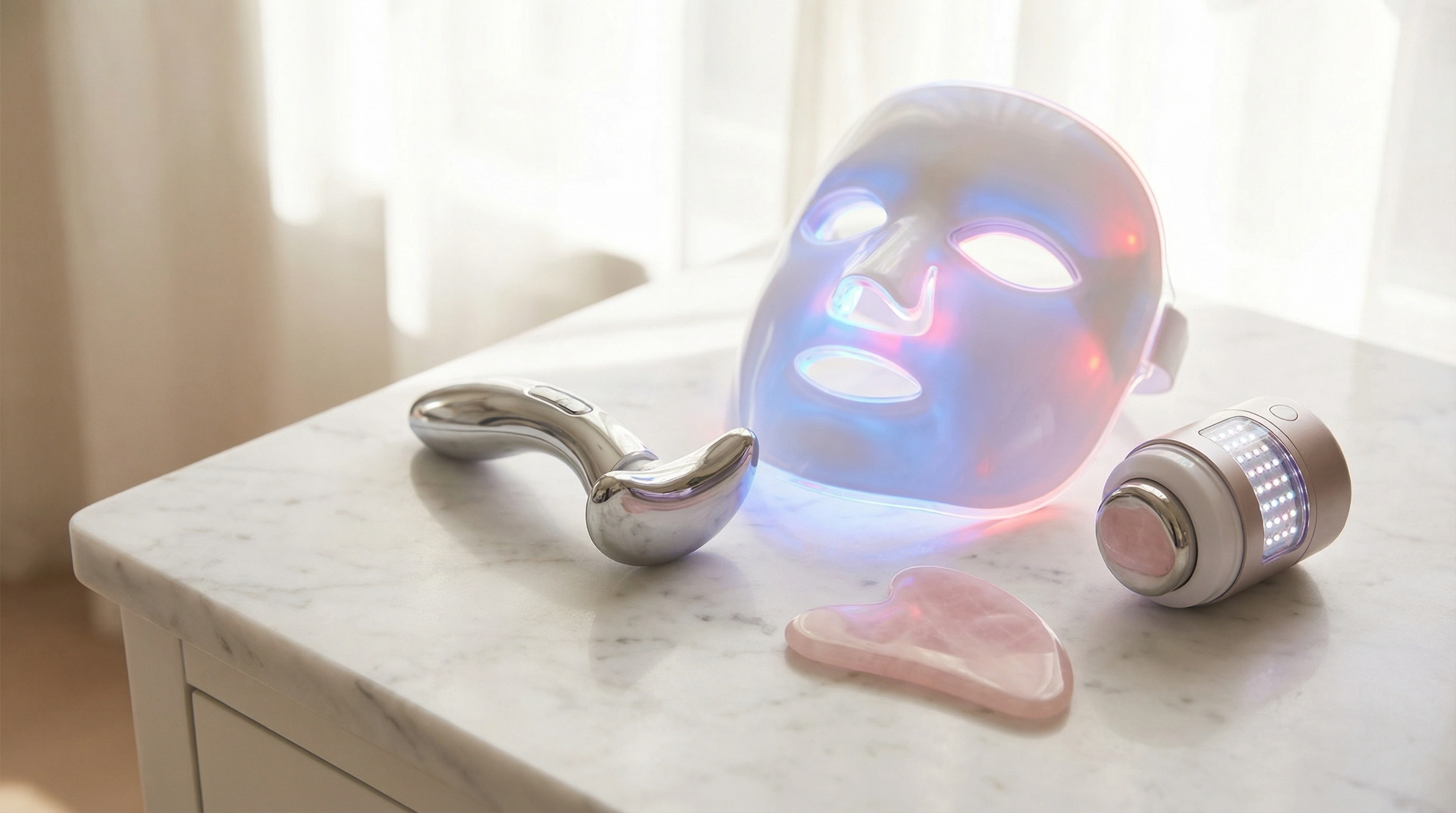
The practice grew out of decades of research into photobiomodulation: the study of how light at particular wavelengths interacts with cells. It moved from labs and dermatology clinics into homes once LED technology made the right wavelengths cheap, cool-running, and safe to use unsupervised. Today it spans full-body panels, masks, and handheld devices like our 3-in-1 face massager, whose red mode runs at the studied 630 nm wavelength.
This guide is the simple version: what it is, what to expect, and how to start. For the deeper dive into the research, mechanisms, and the celebrity-trend hype filter, read our companion piece: what does red light therapy actually do?
- Red light630-660 nmStudied for skinvisible red for skin-surface concerns, no UV
- Near-infrared800+ nminvisible and penetrates deeper, used in some panels
How does red light work in the skin?
Red light at 630–660 nm penetrates a few millimeters into skin, where it is absorbed by mitochondria, the energy producers inside your cells[2]. The leading explanation is that this absorption nudges cells to produce energy more efficiently, which supports the skin’s normal renewal processes, including collagen production.
The most-cited human evidence is a 2014 controlled trial[1] (Wunsch & Matuschka, Photomedicine and Laser Surgery): participants who received red and near-infrared light sessions twice a week showed measurably higher collagen density on ultrasound, smoother skin texture, and a visible reduction in fine lines compared with controls after 30 sessions. Effects were gradual and cumulative, which is exactly how you should expect it to behave at home.
Two honest framing notes: wavelength matters (630–660 nm for skin-surface concerns; near-infrared 800+ nm goes deeper) and dose is modest: more is not better, consistency is better.
- Red light630-660 nm · absorbed by mitochondria in the dermis
- Near-infrared800+ nm · penetrates deeper still
It helps to know what red light is not, because that is where most confusion lives. It is not a laser, it does not tan, and it carries no UV: the wavelengths sit at the opposite end of the visible spectrum from the ultraviolet range that damages skin. Dermatology reviews describe light-emitting diodes as a well-tolerated way to deliver these wavelengths at home, with the realistic expectation of gradual support for skin appearance rather than a dramatic or immediate change.[3] That framing, gentle and cumulative, is the honest baseline every buying decision should start from.
What results can you realistically expect?
Realistic expectations: a gradual improvement in how skin looks (tone evenness, texture, radiance, and the softening of fine lines) emerging over 4–8 weeks of consistent use. Anyone promising a transformation in days is selling something other than the research.
- Weeks 1–2: mostly ritual benefits. The warm-light session feels good and anchors a routine. Some people notice a temporary healthy flush right after.
- Weeks 3–4: the first changes most people report: skin looking “rested,” makeup sitting better, a subtle evenness.
- Weeks 5–8: where the trial-documented changes (texture, fine lines, firmness-feel) show up for consistent daily users.
What RLT will not do: replace sunscreen, undo deep static wrinkles, or compensate for sleep deprivation. It is a compounding supportive habit: the skincare equivalent of daily walks, not surgery.
- Weeks 1-2Mostly ritual; the warm-light session feels good. Some notice a temporary flush.
- Weeks 3-4Skin looking rested, makeup sitting better, a subtle evenness.
- Weeks 5-8Where trial-documented texture, fine-line and firmness-feel changes show up.
Put numbers on the expectation and disappointment gets much less likely. The clinical work that showed skin change used repeated sessions over roughly ten or more weeks, and at-home users trade the lower power of consumer devices for higher frequency, which is why daily five-minute sessions are the standard advice. Weeks one and two are mostly ritual. The first rested look tends to arrive around weeks three and four, and the texture and fine-line changes documented in trials land later still. Anyone promising a visible transformation by the weekend is describing marketing, not the research.
How do you start a red light routine at home?
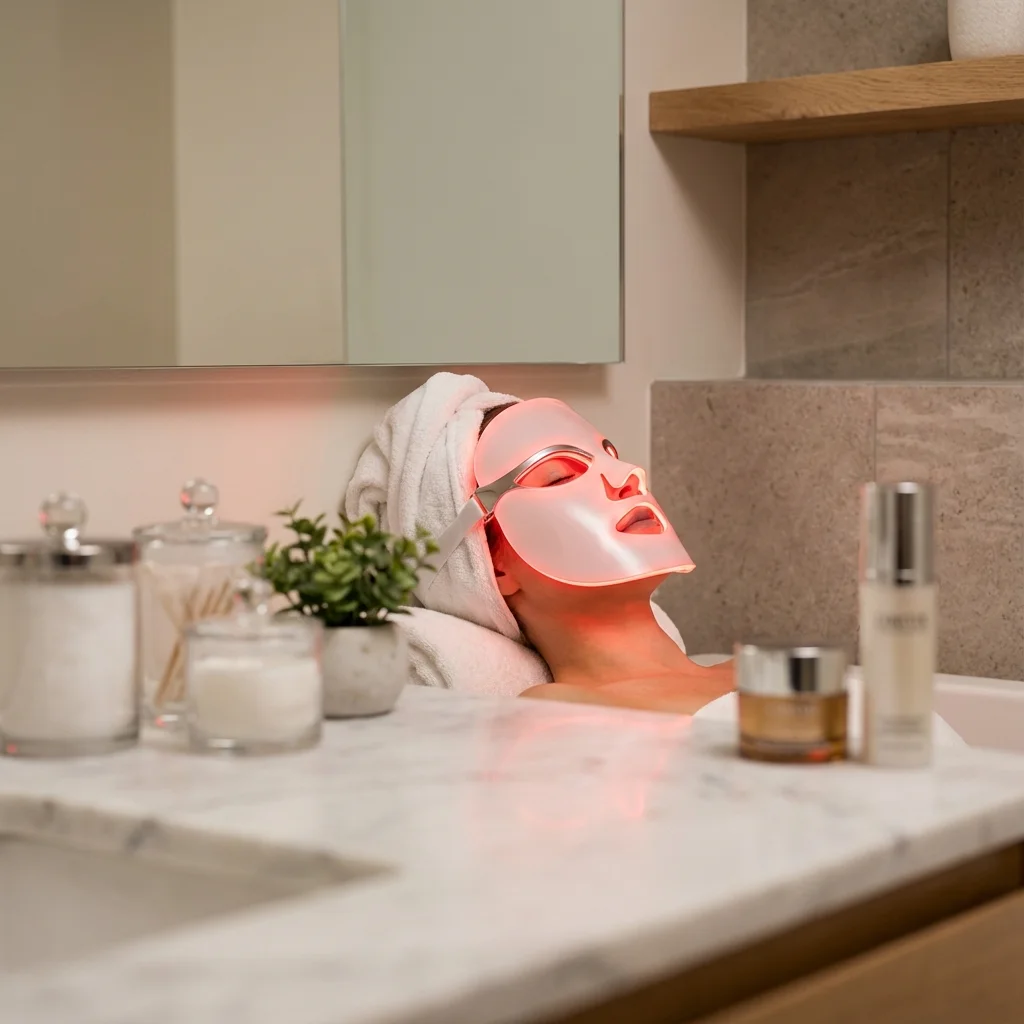
Start with five minutes a day on clean skin, build to ten, and attach the session to a routine you already never skip. Evening cleansing is the classic anchor. The device matters less than the habit; the habit is everything.
- Cleanse first. Light reaches skin best with nothing blocking it: remove makeup and sunscreen.
- Apply a light serum if you like. With a contact device like the Viminto 3-in-1, a few drops of serum also help it glide; its warmth and vibration pair the light with a mini facial-massage.
- Run the session. Five minutes, slow passes over cheeks, forehead, jaw, neck. The auto-shutoff handles timing so you never overthink it.
- Finish your normal routine. Moisturizer after; sunscreen as usual in the morning.
That is genuinely the whole protocol. If you want to slot it into a fuller evening stack alongside other devices, our daily wellness tech routine maps the order that works.
How often should you use red light therapy?
Daily or near-daily, 5–10 minutes per session, indefinitely. Red light is a consistency practice, not a course of treatment you finish. The clinical trials that showed results used multiple sessions per week over 10+ weeks; at-home users compensate for lower-powered devices with daily frequency.
Practical scheduling truths:
- Five daily minutes beat one weekly hour. Cellular responses to light are dose-and-repeat phenomena; cramming does not bank results.
- Missing a day is irrelevant; missing a month is a reset. Think of it like flossing or walking.
- Results plateau pleasantly. After the initial 8-week arc, continued use maintains; many people drop to 4–5 sessions a week at that point.
Is red light therapy safe?
For most people, yes. Red light at consumer-device intensities is one of the gentlest practices in skincare: no UV, no exfoliation, no downtime, and decades of study at these wavelengths without serious safety signals. A few common-sense rules still apply.
- Don’t stare into the LEDs. Red light is not a laser, but bright light close to the eyes is uncomfortable. Keep eyes closed when working near them.
- Photosensitivity is the exception case. If you take medication that increases light sensitivity, or have a light-triggered condition, ask your doctor before starting.
- Pregnant or managing a skin condition? Same answer: a quick question to your doctor or dermatology professional beats internet certainty.
- Follow the device’s session guidance. Auto-shutoffs exist so enthusiasm cannot turn into overuse.
This article is wellness education, not medical advice. For any skin concern that worries you, a professional who can look at your skin wins.
Sources & References
All claims in this article are supported by peer-reviewed research, clinical studies, and reputable sources. Click any reference to view the original source.
- 1Wunsch A, Matuschka K (2014)A controlled trial to determine the efficacy of red and near-infrared light treatment in patient satisfaction, reduction of fine lines, wrinkles, skin roughness, and intradermal collagen density increasePhotomedicine and Laser SurgeryWunsch A, Matuschka K. A controlled trial to determine the efficacy of red and near-infrared light treatment in patient satisfaction, reduction of fine lines, wrinkles, skin roughness, and intradermal collagen density increase. Photomedicine and Laser Surgery. 2014;32(2):93-100.CLINICAL TRIALView Source
- 2Avci P, Gupta A, Sadasivam M, et al. (2013)Low-level laser (light) therapy (LLLT) in skin: stimulating, healing, restoringSeminars in Cutaneous Medicine and SurgeryAvci P, Gupta A, Sadasivam M, et al. Low-level laser (light) therapy (LLLT) in skin: stimulating, healing, restoring. Seminars in Cutaneous Medicine and Surgery. 2013;32(1):41-52.JOURNALView Source
- 3Barolet D (2008)Light-emitting diodes (LEDs) in dermatologySeminars in Cutaneous Medicine and SurgeryBarolet D. Light-emitting diodes (LEDs) in dermatology. Seminars in Cutaneous Medicine and Surgery. 2008;27(4):227-238.JOURNALView Source
Disclaimer: This information is for educational purposes only and is not medical advice. VIMINTO® devices are designed for wellness and cosmetic use. Results may vary. Consult a healthcare professional for medical concerns.