Key Takeaways
- The honest hierarchy: daily sun protection first by a wide margin: up to 80–90% of visible facial aging tracks to cumulative UV, not birthdays
- The landmark proof: a 4.5-year randomized trial (Hughes 2013, 903 adults) found daily sunscreen users showed no detectable increase in skin aging
- Retinoids are the most-studied renewal topicals: OTC retinol is the at-home entry; prescription strengths are doctor territory
- Devices are the consistency layer: red LED has the strongest at-home evidence, with changes clustering at weeks 4–8 of daily five-minute sessions
- Four unglamorous habits outwork most products: sleep, not smoking, moderating alcohol, and limiting added sugar (glycation stiffens collagen)
What actually slows visible skin aging?
In order of evidence: daily sun protection first (by a wide margin) then retinoids, then consistent habits and supportive technology like red LED. The honest hierarchy matters because the cheapest item on the list does the most work, and no device or cream higher up can compensate for skipping it.
That ranking is not opinion. Up to 80–90% of the visible changes we call “facial aging” (deep wrinkles, rough texture, uneven pigment) track to cumulative UV exposure rather than birthdays[2]. Everything else in this article is meaningful, but it is all second place.
This guide walks the hierarchy from top to bottom: why creams alone underdeliver, the one study every sunscreen claim leans on, where retinoids and at-home devices genuinely fit, and the daily habits that quietly compound.
The honest anti-aging hierarchy
- 1Daily sunscreenFirst by a wide margin. Up to 80-90% of visible aging is cumulative UV.
- 2RetinoidsThe most-studied renewal topicals. OTC retinol is the at-home entry.
- 3DevicesThe consistency layer. Red LED has the strongest at-home evidence.
- 4Daily habitsSleep, not smoking, less alcohol and sugar. They outwork most products.
Why are creams alone not enough?
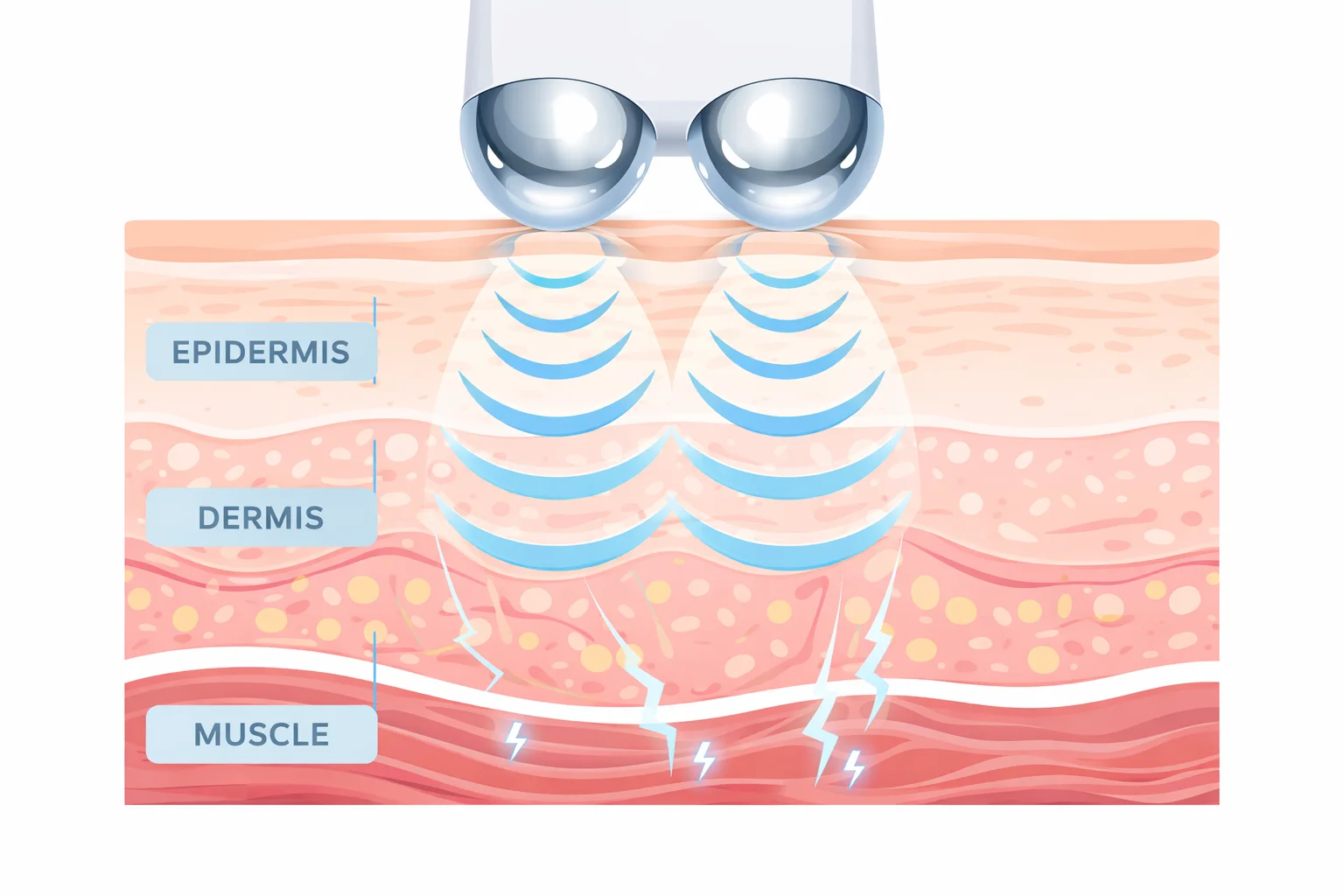
Because most over-the-counter creams work at the surface (hydration, temporary plumping, barrier support) while visible aging is driven by deeper processes: collagen breaking down faster than it rebuilds, cell turnover slowing, and UV damage accumulating in the dermis. A good moisturizer makes skin look better today; it does not change the trajectory.
The three mechanisms doing the damage:
- Collagen loss. From our mid-20s, skin loses roughly 1% of its collagen per year[4]. UV exposure and oxidative stress accelerate the breakdown side of the ledger.
- Slower renewal. Cell turnover stretches from ~28 days in youth toward 40–60 days later in life, which reads as dullness and rougher texture.
- Cumulative UV. The dominant driver, and the only one with a near-perfect protective tool available at every drugstore.
Hydration still matters: it is simply the maintenance layer, not the strategy.
What is the single most evidence-backed step?
Daily sunscreen, and there is a landmark trial behind the claim. A 4.5-year randomized study of 903 adults in Australia (Hughes et al., 2013, Annals of Internal Medicine) found that daily sunscreen users showed no detectable increase in skin aging over the study period, while discretionary users aged measurably[1]. Daily use beat occasional use; nothing else in skincare has produced a result that clean.
The practical translation:
- Daily means daily: cloudy days, desk days, winter. UVA penetrates glass and cloud cover.
- SPF 30+ broad-spectrum is the floor; the formula you will actually wear daily beats a stronger one you avoid.
- It protects your investment: every result from retinoids, devices, or diligence below is collagen that sunscreen keeps from being torn back down.
Where do retinoids fit?
Retinoids are the most-studied topical category for skin renewal. They speed cell turnover and support collagen, with decades of research behind them. The prescription-strength versions are doctor-supervised territory and outside what a wellness brand should advise on; the over-the-counter relative, retinol, is the gentler at-home entry point most people start with.
If you add retinol, the universally-repeated guidance: start low (0.25–0.5%), two or three nights a week, behind a moisturizer if needed, and expect an adjustment period of mild dryness. Build frequency slowly over weeks. It pairs fine with device routines, just not in the same evening session while skin is adjusting.
One honest boundary: questions about prescription options, strong irritation, or persistent skin concerns belong with a doctor or licensed skin professional, not a blog, ours included.
What can at-home devices genuinely do?
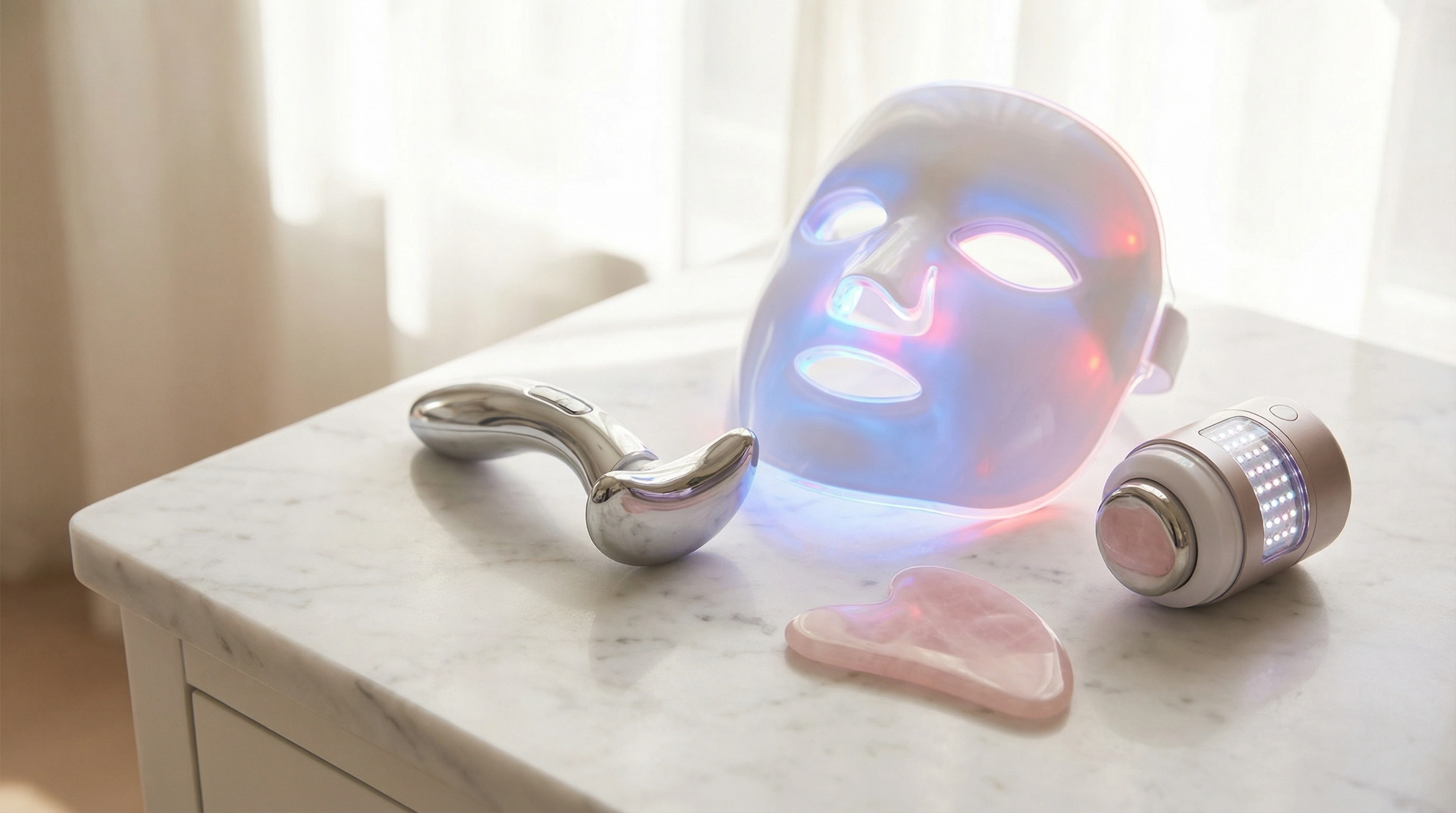
Devices are the consistency layer: modest, cumulative support delivered in minutes a day. Red LED has the strongest at-home evidence. A 2014 controlled trial measured higher collagen density and reduced fine lines after 30 sessions[3], while microcurrent and massage tools add a toned look and circulation benefits that reward regular use.
Set expectations like an investor, not a believer: device changes arrive over 5–12 weeks, look like “rested” before they look “different,” and persist only while the habit does. We compared the three main modalities honestly (mechanisms, evidence files, costs) in our devices comparison, and the light science lives in our red light guide.
Our own entry in this layer is the VIMINTO 3-in-1 Face Massager: 630 nm red LED, gentle 42°C warmth, and vibration massage in one five-minute pass, built for exactly the daily-consistency role this section describes.
The device layer earns its place precisely because it is easy, not because it is powerful. The most-studied at-home wavelength range, red light around 630–660 nm, produced measurable collagen-density and fine-line changes in controlled trials, but only after weeks of consistent sessions and always as support rather than a replacement for sun protection.[3] Think of it as the habit that compounds while the two non-negotiables, daily sunscreen and not smoking, do the heavy structural work. A five-minute pass you actually keep will out-deliver a clinic-grade panel you use twice and forget, which is the whole case for choosing the tool that fits your real morning.
Which daily habits actually move the needle?
Four habits show up across the longevity-of-skin literature: sleep (7–9 hours: growth hormone and repair run at night), not smoking (the second-fastest visible ager after UV), moderating alcohol, and managing added sugar, which stiffens collagen through glycation. None is glamorous; together they outwork most products.
- Sleep is when skin repair peaks: chronic short sleep shows up as slower recovery and duller tone.
- Smoking constricts skin circulation and degrades collagen directly; quitting is the single biggest non-UV improvement available.
- Alcohol dehydrates and inflames; the difference between rare and nightly shows in skin within weeks.
- Added sugar cross-links collagen fibers (glycation), making them stiffer and more wrinkle-prone over years.
Slot these under the routine from our daily wellness tech guide and the products become the easy part: sunscreen every morning, five LED minutes a day, retinol a few nights a week, and habits doing the silent heavy lifting.
The order of operations is what most anti-aging marketing gets backwards. Spending on a serum before you have locked in daily sunscreen is like buying performance tires for a car with no oil in it: the expensive part cannot cover for the cheap part being skipped.[2] Sun protection first, then a retinoid if your skin tolerates it, then sleep and not smoking, then supportive habits and devices. Nothing in that list is exotic, and nothing lower on it rescues a gap higher up. The science of looking younger for longer is mostly the discipline of doing the boring, proven things on the days you do not feel like it.
Sources & References
All claims in this article are supported by peer-reviewed research, clinical studies, and reputable sources. Click any reference to view the original source.
- 1Hughes MC, Williams GM, Baker P, Green AC (2013)Sunscreen and prevention of skin aging: a randomized trialAnnals of Internal MedicineHughes MC, Williams GM, Baker P, Green AC. Sunscreen and prevention of skin aging: a randomized trial. Annals of Internal Medicine. 2013;158(11):781-790.CLINICAL TRIALView Source
- 2American Academy of Dermatology11 ways to reduce premature skin agingAmerican Academy of DermatologyAmerican Academy of Dermatology. 11 ways to reduce premature skin aging. American Academy of Dermatology.OTHERView Source
- 3Wunsch A, Matuschka K (2014)A controlled trial to determine the efficacy of red and near-infrared light treatment in patient satisfaction, reduction of fine lines, wrinkles, skin roughness, and intradermal collagen density increasePhotomedicine and Laser SurgeryWunsch A, Matuschka K. A controlled trial to determine the efficacy of red and near-infrared light treatment in patient satisfaction, reduction of fine lines, wrinkles, skin roughness, and intradermal collagen density increase. Photomedicine and Laser Surgery. 2014;32(2):93-100.CLINICAL TRIALView Source
- 4Cleveland ClinicCollagen: What It Is, Types, Function and BenefitsCleveland ClinicCleveland Clinic. Collagen: What It Is, Types, Function and Benefits. Cleveland Clinic.OTHERView Source
Disclaimer: This information is for educational purposes only and is not medical advice. VIMINTO® devices are designed for wellness and cosmetic use. Results may vary. Consult a healthcare professional for medical concerns.